
Solarpunk Selves Aren't Liberal Individuals
Defining the Solarpunk Self, Part 2

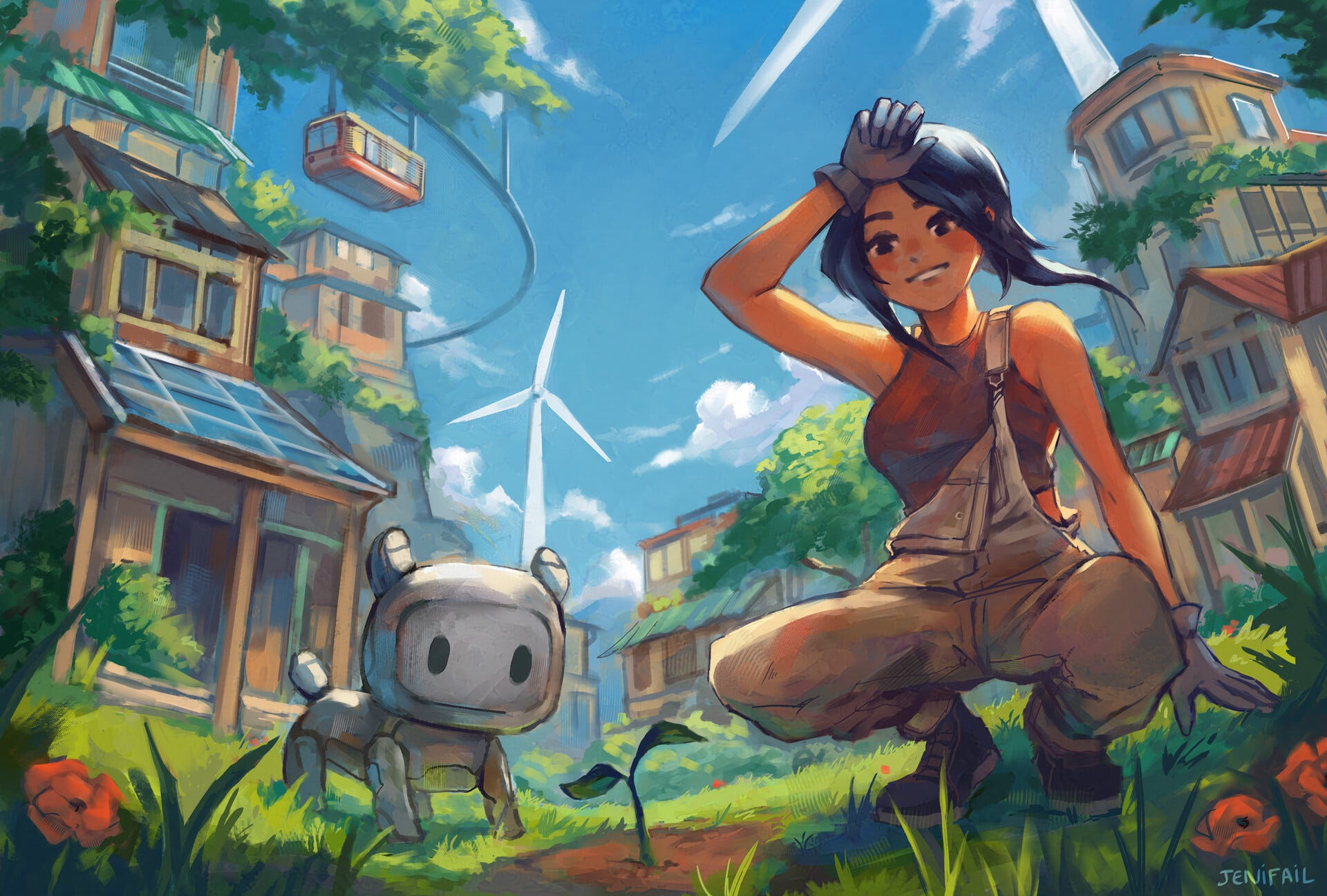
In creating a solarpunk society, we need a conception of the self that is grounded in ethical relationships. We have to become the kind of person who can actually achieve that goal because most of us have been indoctrinated into a cult of neoliberal capitalism, and despite our best efforts, this actually prevents us from engaging in truly ethical relationships. At the core of this ideology is the damaging expectation that every adult be a “liberal individual”. This is so damaging because…such an individual doesn’t seem to exist.
Such dilemmas have led me to this series of essays on an attempted redefinition of the self in a solarpunk culture. While each essay is written to stand on its own, together they constitute a full picture that is important to see in its entirety. As with all of my essays, I apply theory to my own life and experience, but end the essay with principles of application for your own situation. So, if you like this essay, which is the second, then consider starting at the beginning with Solarpunk Selves and Sexual Ethics.
Okay, so, the Liberal Individual doesn’t seem to exist…but what the hell is a Liberal Individual?
This is the autonomous, rational actor who in their pursuit of their own self-interest, allows modern, capitalist liberal democracies to flourish.1,2 In other words, if you live in the West especially, then you are expected to be such an individual on the day you turn 18 – 21 years old. From here on out your life is your life and your failures are your failures, whether that involves sex, drugs, or military service invading South American countries to “liberate” them.
Remember that a through line for this series has been that sexual relations are exemplary of the ethical.3 When it comes to sex and dating, we expect people to either already know what to do or to be able to figure it out on their own. You’re an adult now and you ought to be able to figure it out on your own using logic, reason, and a little bit of initiative goddammit. If not, then you’re a stunted adult, a child in a man’s body, a little girl looking for daddy, and it is entirely your own responsibility to grow up.
The philosopher Virginia Held questions this definition:1
“A glaring deficiency of the liberal image of the individual citizen is that it abstracts from an interconnected social reality, taking the ideal circumstances of an adult, independent head of a household as paradigmatic and ignoring all the rest. It overlooks the social relations of an economy that makes its members (including heads of household) highly interdependent.”
In other words, think about how deeply influenced you have been throughout your life. Your mother breast-feeding you, your father playing catch, your teachers and classmates educating you through schoolwork and recess politics. All of these experiences, in their presence or absence, shaped and molded the “adult” you are today. The economic system itself, supposedly composed of only self-interested actors, is what makes it possible for you to pursue whatever goals you have. You cannot be a breadwinning provider without all the people who make society possible.
What happens then, when who you are today is shaped far more by the absence of the beautiful things than their presence? A personal experience in the Montreal subway can demonstrate very clearly how debilitating this can be. This story gets really dark so prepare yourself.
There was already a bit of a commotion the moment I stepped onto the car. People were either staring at or avoiding a homeless First Nations woman, maybe somewhere around 50, who was visibly agitated and muttering to herself. At one point she started screaming, “fuck you! I hate you! I hate all of you! Fuck a penis! A penis! Fuck all of you!”
By the time I got off the train a few minutes later she had been reduced to repeating, “ow,” in a voice that was eerily reminiscent of a little girl. I have no idea if what I’m about to say is true about her, but knowing what I know about psychology it very well could be. Some psychological theories say that traumatic experiences can cause us to fragment into parts that continue living within our mind, sometimes at the same age we were at the moment of the trauma. When we get triggered, that part takes us over and we may literally begin living as if we were that part of us at the age the trauma happened.4
Consider then what this woman said, “Fuck a penis. A penis.”
Was she, in that moment, being taken over by a part that had been broken off because of a rape she’d experienced? In that moment, was she literally reliving that memory, screaming at the penis who had violated her?
Remember also that she, an adult liberal individual, was reduced to “ow”, repeating it to herself like a 5 year girl who was holding a scraped knee. How old was she when she was raped? If she was 5, who was the man who was likely to have done it? Her father? A different family member? A family friend, a priest, a teacher, who in a position of trust and authority betrayed that trust and broke that little girl into pieces?
Our obsession with the liberal individual in all their adult capacities as the rational, autonomous actor has too many people look at her and spit, “junkie,” demanding she take personal responsibility for her situation and get a fucking job. All they see from the outside is someone they feel justified in judging. They’re completely unaware that they’re spitting on what is, effectively, a 5 year old girl crying “ow” because she’s just been raped by a teacher in a residential school she was stolen from her family to attend.
Again, whether or not this is what actually happened to this specific woman is irrelevant. This is how psychology can work and we know full well that people like her often come from horrifying abuses.5 And yet, people simply see an adult, expect the liberal individual, and then demand that this person meet that expectation or it’s all their fault and all their responsibility.
When we look to men and see their dating issues, which can range from awkwardness to aggressive creepiness, we see an adult and expect a liberal individual. I don’t mean to compare the average man’s life to this woman’s. It’s clear that she is a horrifyingly tragic extreme case. However, through that extreme case we can begin to see how bound up with other people this allegedly autonomous, independent liberal individual truly is and thus, how bound up we all are.
So, personally, my early years included a single mother taking care of me during a heart surgery before I was 3. Around the age of 4, we fled in the middle of the night from the abusive man who’d hidden his alcoholism from her until marriage, and then at the age of 7, I was sexually molested. We then moved around the age of 9 where I oscillated between daily bullying at school and social isolation on a farm. I was then exposed to the sweet acceptance and intimacy of porn at the age of 12, eventually finding myself watching more extreme genres like gangbangs by the age of 15.
The fact that I emerged out of that with some moderate social anxiety is surprising only in the lack of severity. Does it seem likely that I would have issues becoming what Hirsch and Khan call a sexual citizen, a liberal individual capable of sexual self-determination and respecting the same in others?6 Would I be capable of accessing what Queer legal theorist Dr. Fischel calls a democratically hedonic sexual culture?7 Does such a culture even exist for most people to access, let alone those of us who’ve had difficult childhoods?
Is it any wonder then that once I was outwardly an adult I found myself still a child, still incapable of sexual agency or communion? Is it any wonder then that I would find such motivation in a worldview that sees relationships as Red Pill Godfather Tomassi writes here:8
“In any relationship, the person with the most power is the one who needs the other the least.”
Finally! A pathway to becoming an adult! A self-interested, autonomous liberal individual who was able to create the relationships with woman that answered the fundamental premise of pickup artistry, “I suck at talking to women, and I want to learn how so that they are excited about the possibility of sex or romance with me.”
Perhaps my story has triggered empathy from you. Perhaps you can see how I would have had such difficulties building and maintaining healthy, ethical relationships in general, let alone with women. Yet, many men have great childhoods and find themselves far more disrespectful of, let alone incapable with women. Dr. Held can help us here:1
“For liberalism, as we have seen, individuals are conceptually and normatively prior to social relations or groups. It is assumed that we should start in our thinking with independent individuals who can form social relations and arrangements as they choose and that the latter only have value instrumentally to the extent that they serve the interests of individuals.”
Many men don’t have the capacity to create relationships. That’s the whole point of learning pickup in the first place. With the average age of first viewing porn now being 13, is it any wonder that so many men, who were already being raised in a patriarchal society, desperately need better dating education?9 We can rage all we want about how men should know this or should know that, and yet the fact of the matter is that we continue to have these problems. We can’t demand the actualization of respectful, post-patriarchal men while denying men the compassionate education they would need to become post-patriarchal.
Dr. Kegan has a concept called the developmental demands of a culture’s curriculum.10 If a culture has a certain set of tasks, challenges, and problems, and the average citizen is incapable of meeting that curriculum, then it has, at the very least, an unjust education system.
86% of men in supposed adulthood lack the ability to flirt.11 Yet, our culture demands that they already know how to in a fun, respectful enough way to create a satisfying romantic life. That means our cultural curriculum places demands that exceed the development the average man has. Our education systems fail to produce a man that can fit into his environment well enough to function. This is made all the more unjust when you consider that this system includes 12 years of mandatory education that nearly every man is put through.
Dr. Held critiques this lack of functional fittedness:1
“Thinking of society’s members, then, as if they were fully independent, free, and equal rational agents obscures and distorts the condition of vast numbers of them at the very least and has the effect of making it more difficult to address the social and political issues that would be seen as relevant and appropriate if these conditions were more accurately portrayed and kept in view. The liberal portrayal of the self-sufficient individual enables the privileged to falsely imagine that dependencies hardly exist, and when they are obvious, to suppose they can be dealt with as private preferences, as when parents provide for their infants. The illusion that society is composed of free, equal, independent individuals who can choose to be associated with one another or not obscures the reality that social cooperation is required as a precondition of autonomy.”
We could look to the myriad ways in which boys and men are privileged over girls and women, and yet fail to see what bell hooks has come to be so beloved for pointing out.12 Men are victims of patriarchy too. To rail against the harsh curriculum of the patriarchal male, but to then blame them for being the ethically inadequate products of that curriculum, is a failure of the very social cooperation that we need in order to help these men become post-patriarchal.
If you are a man who is incapable of cooperating with women, whether romantically or platonically, then by Held’s definition you are incapable of the autonomy necessary to be able to become capable. It’s not just a lack of flirting, it’s a lack of capability to learn how to flirt because you don’t already know how to flirt or socialize well enough.
Once again, Dr. Held so beautifully writes:1
“the human bonds of families, friends, groups, and nations are relegated to the status of the ‘merely sentimental’ or the ‘instinctual,’ ‘natural,’ ‘emotional,’ and ‘irrational,’ as opposed to the rational and the moral. They are then regarded as lying ‘outside morality’ and are left unexamined from the moral point of view in a region to be empirically described but about which morality is thought to have nothing to say.” (emphasis added, internal citation number removed)
With all of that being said, she doesn’t claim that autonomy is impossible:1
“Thinking of persons as relational does not mean that we cannot make autonomous choices to resist various of the social ties we grew up with or find ourselves in and to reshape any relations we maintain. On the contrary, it often requires that we do so.”
And yet:1
“Persons without adequate resources cannot adequately exercise autonomous choices. Autonomy is exercised within social relations, not by abstractly independent, free, and equal individuals.”
In other words, autonomy is not something we are born with, but something that must be fostered. Hirsch and Khan claim that the sexual citizen is not born, but is a capability that must also be fostered. If we want a sexual citizen that is capable of sexual agency, the pursuit of self-interested goals, and sexual communion, the pursuit of other-interested care, then we must have a far better understanding than the liberal individual.13
In the next essay, we’ll be going more deeply into the limits of the liberal individual and the necessity of a relational dividual.
Principles of Application:
1. Each essay I write has this section. Sometimes multiple essays’ will build on each other, other times they’ll be self-contained. Remember that you’re answering these in the context of creating solarpunk.
2. In previous essays you chose a facet of your gender, identity, ideology, politics, etc., that you’d like to understand with greater complexity. Consider the relationships from which it was created. Choose two (or more) of the most important relationships, one good and one bad.
3. Of the good, how was it good? How was it bad?
4. Of the bad, how was it bad? How was it good?
Until then, thank you so much for your time and attention. Please hit the like button and subscribe for more conversations on solarpunk, psychological development, and the cultivation of a personal mythology. Thanks again, and all the best to you on whatever journey you find yourself on.
References:
1 – Held, V. (2006). The Ethics of Care: Personal, Political, and Global. Oxford University Press.
2 – Freinacht, H. (2019). Nordic Ideology: A Metamodern Guide to Politics, Book Two. Metamoderna ApS.
3 – Anderson, E. (2019). From Existential Alterity to Ethical Reciprocity: Beauvoir?s Alternative to Levinas. Continental Philosophy Review, 52(2), 171–189. https://doi.org/10.1007/s11007-018-9459-3
4 – Schwartz, R. (2021). No Bad Parts: Healing Trauma and Restoring Wholeness with the Internal Family Systems Model. St. Martin’s Essentials / Sounds True.
5 – Maté, G. (2009). In the Realm of Hungry Ghosts: Close Encounters with Addiction. Vintage Canada.
6 – Hirsch, J. S., & Khan, S. (2020). Sexual Citizens: A Landmark Study of Sex, Power, and Assault on Campus. WW Norton.
7 – Fischel, J. (2019). Screw Consent: A Better Politics of Sexual Justice. University of California Press.
8 – Tomassi, R. (2013). The Rational Male. CreateSpace Independent Publishing Platform.
9 – Evidence on pornography’s influence on harmful sexual behaviour among children. (n.d.). Children’s Commissioner for England. Retrieved January 20, 2026, from https://www.childrenscommissioner.gov.uk/resource/pornography-and-harmful-sexual-behaviour/
10 – Kegan, R. (1997). In Over Our Heads: The Mental Demands of Modern Life. Harvard University Press.
11 – Apostolou, M., O, J., & Esposito, G. (2020). Singles’ Reasons for Being Single: Empirical Evidence From an Evolutionary Perspective. Frontiers in Psychology, 11. https://doi.org/10.3389/fpsyg.2020.00746
12 – hooks, bell. (2005). The Will to Change: Men, Masculinity, and Love. Washington Square Press.
13 – Abele, A., & Wojciszke, B. (Eds.). (2019). Agency and Communion in Social Psychology. Routledge.
This is brillant work connecting Kegan's developmental curriculum to the broader relational critique. The observation about 86% of men lacking flirting ability while the culture expects mastery really exposes the gap. I've seen this play out in workpalce settings where people are expected to navigate complex social hierarchies withut any formal training. What might be interesting is exploring how solarpunk communities could explicitly design developmental pathways rather than hoping people figure it out.