
Introducing a Solarpunk Mythos
An Aspirational Vision of the Future

If you prefer YouTube or Spotify, then please click the link.
The American Empire is failing.
I want you to sit with that for a little bit. To think about all the things happening right now in the world that are associated with that end.
Here’s a chart to show you why this is happening:
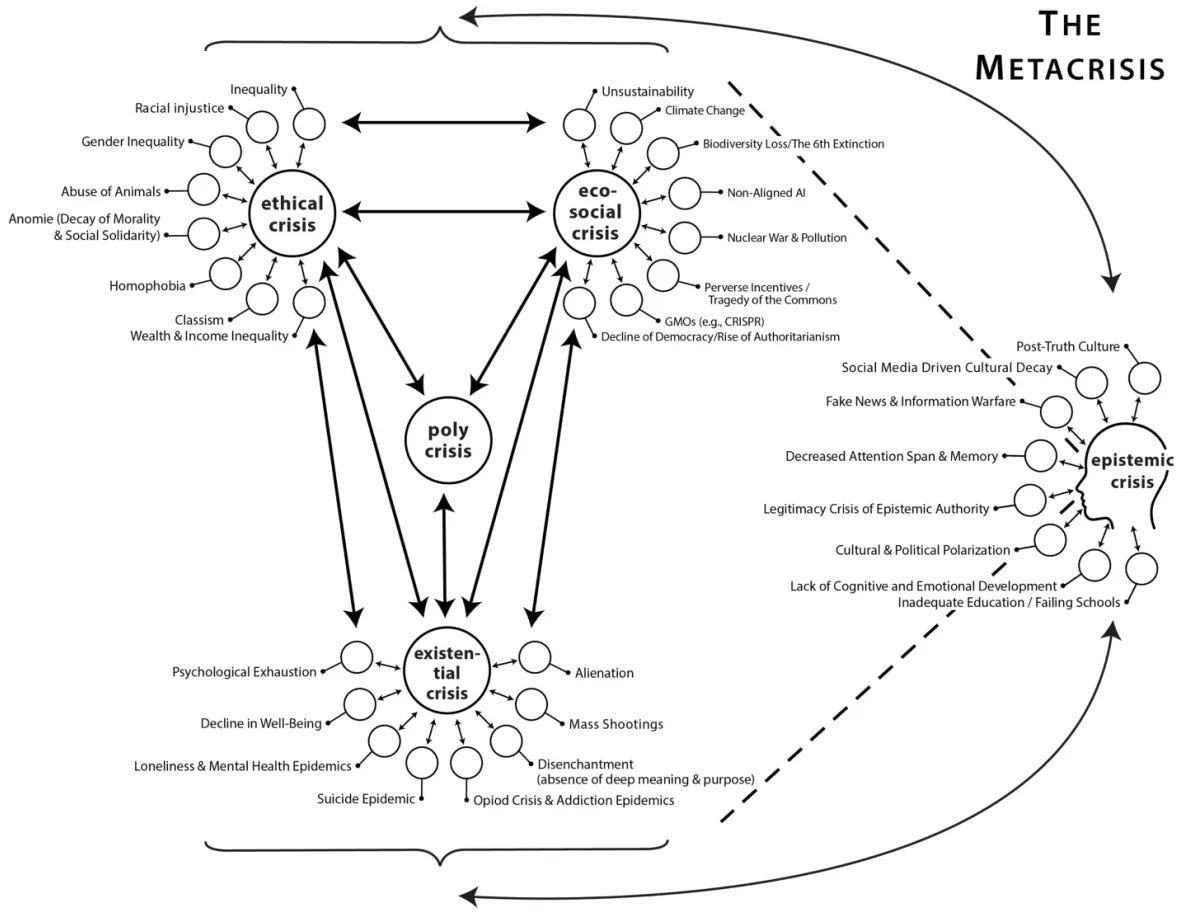
Looks terrifyingly unmanageable. These crises are collectively known as the meta-crisis, and it may be that framing them as crises is actually making them even worse.1
Sorry for being a Debby Downer on our first meeting, and sorry Debby, but really, this is a pretty wicked problem. We can cheer all we want about the end of American hegemony, but the causes and consequences are significant enough to turn that smile upside down. It can be easy to become hopeless, nihilistic, and bathe ourselves in the endless, mindless hedonism of the digital. Personally, I’m not really down for that.
“But what then, can we do?”
Daniel Schmachtenberger offers one of the most beautiful quotes I have ever heard:1
“Asking me for a solution is like asking me what species the forest is.” (paraphrased)
His point is that a problem space is better conceived not in some linear way where we create a solution, fix the problem, and everything is fine. Instead, we want to see how a problem space is a living, breathing ecology. This solution is a predator for that problem, but prey for the next. Even worse, that solution is the predator of a problem plus a whole host of other solutions we didn’t even realize we depended upon.
If we want to solve the wicked problems of the meta-crisis, then we need an ecology of solutions that are evolutionary, tilting the ecosystem in a direction we want.
“So you’re a reformist, not an abolitionist?”
I’m both, depending on the context, because the demand to choose is my point. In some cases reform could perpetuate or even empower the very system it seeks to change. In other cases, abolition might create unforeseen consequences that cause a reactionary reversal to an even worse situation than we started with. Choosing abolitionism or reformism as the approach across all situations is willful ignorance to the complexity of change.
With such a whirlwind of complexity, the idea that I or anyone else could possibly provide a solution is ridiculous. It is instead always we who must work together in order to create the change we want. I seek to provide education perhaps most obviously related to the epistemic crisis, what we know and how that relates to our own cognition. Much of my work will touch on the other crises as well, particularly the existential crisis.
However, this is a conversation between you and me. I am not a mentor or a coach. I’m just a reader and a writer, so I’ll undoubtedly get things wrong or miss a piece of the puzzle. In building a solarpunk future we must see each other as collaborators. Whether you collaborate with a read, a like and a share, or become a fellow creator with me, take this piece as an invitation.
Wait, what the fuck is solarpunk?
Put simply, solarpunk is an aesthetic for a future society in which humans have found a way to live in rough egalitarianism, with technology and nature in a symbiotic rather than extractive and exploitive relationship. This image can give you a good feel for solarpunk:
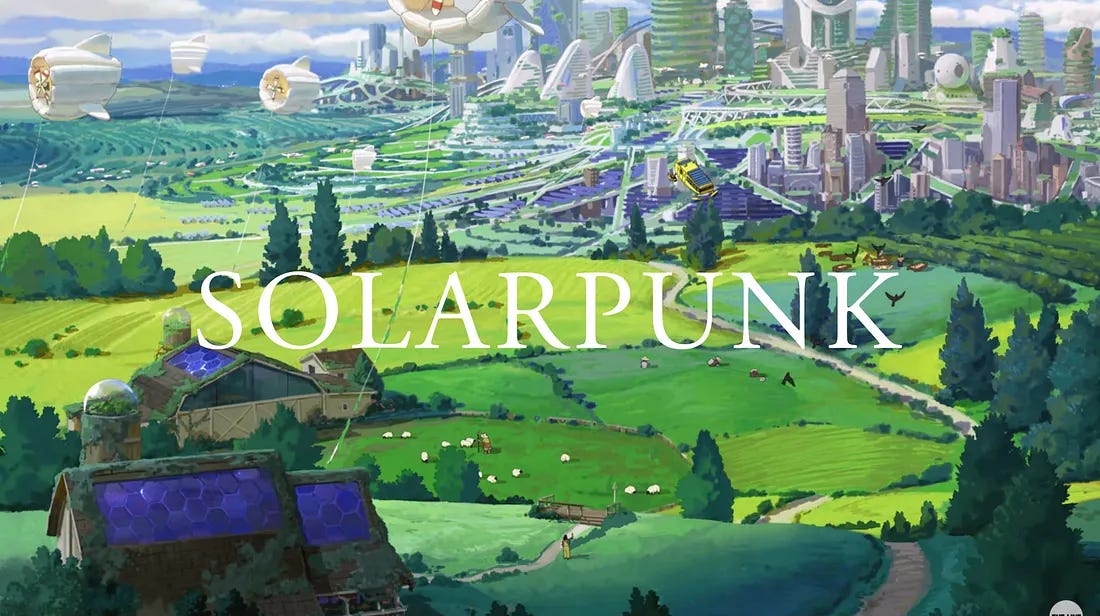
That’s lovely, but…why solarpunk?
Every project needs to have some orienting vision for where it’s headed. By discussing these ideas through solarpunk, I keep in mind the consequences of what I write on the possibility of that vision. To be clear, I don’t intend to mention solarpunk every once in a while to force the ideas I think are interesting into a certain community. When I talk about any idea I want to keep in mind solarpunk precisely because I want something like that kind of society. I also know that by talking about these ideas I am discovering what “that kind of society” actually is.
Many, perhaps even most of us who talk about solarpunk are talking about the aesthetic and the fiction, rather than an actual, workable, adaptable, and stable society with all its on the ground policy and infrastructure. I include myself in that, and so this is why I want to talk about these ideas. They are the pillars of what that society might require, but such pillars must also be understood as being contained within the bounds of aspiration.
Agnes Callard discusses aspiration in terms of prolepsis.2 By definition, if we aspire toward something we can only ever see it from our own perspective. We cannot know what it’s like to be the thing we aspire to because we aren’t yet that thing. This means that we’ll likely be aspiring for the wrong reasons.
She uses the example of someone aspiring to like classical music because it’ll make them appear refined and intellectual. The right reason to aspire to like classical music would be for the love of the music itself.2 Obviously someone may have better reasons for aspiration, but the point is that from their starting point they cannot truly like classical music for its own sake or else they’d already like classical music. They can only move toward that position given the constraints and affordances of where they start.
When it comes to aspiring toward something far more complex, such as an entirely new way of living like solarpunk, we will have a host of bad reasons that might get us in the right direction, but could eventually prevent us from moving forward. Lauren Berlant calls this form of aspiration, “cruel optimism”.3 No matter how optimistic or hopeful we may be, the way in which we aspire keeps us from ever reaching our goal.
My point in saying all of this is to acknowledge the simple reality that however much we might be headed toward something good, we must have the humility to admit when we’re doing it in the wrong way or for the wrong reasons. We may not even realize it until we’re much closer to our destination. This doesn’t mean we should never take action, only that we pause to reflect and hold our beliefs and methods lightly enough to change them.
With this Substack, I intend to discuss ideas and theories that will help us do exactly that. While I may focus on certain topics that aren’t immediately relevant to you, I will be doing my best to use them as case studies for principles that are incredibly relevant to you. I’ll give an example in a moment, but think of my specific topics as test cases for how the principles are applied. I’m going to end most essays with a section called, “principles for application” which will help you apply them to your own situation.
For example, I am going to be spending some time talking about my relationship with masculinity, how that prevents me from creating a solarpunk world, and what I can do to change that. Keep in mind that I’m a cis gender man. I’m perfectly happy being “masculine” and I’ve never had any issues with my gender identity.
And yet, as I become more aware of my gender as a construct, I realize how much it shapes and organizes my self and world, and thus, the path of my becoming. According to Fink, Lacanian psychoanalysis says that the masculine position is one that is most thoroughly defined by patriarchal socialization.4 While the feminine and other genders may be more oppressed, their position as “other” creates an outward push. The fact that the masculine is taken as the ideal creates a tremendous inward pull on men to the center of conformity. Even as we benefit from the patriarchal dividend, that may be the very reason men are far more at the will of patriarchal conformity.
While I may never stop being a man, I aspire to become a post-patriarchal man. Recognize how imbued that is with Callard’s aspiration and the ecology of solution. Does my relationship with masculinity require abolition or reform? I may not be far enough in my journey to know, but by aspiring beyond patriarchy I am at the very least aspiring for the right wrong reasons. In the process of creating this Substack I will slowly move toward better wrong reasons until one day I will be close enough to figure out what I’m truly trying to create, which, hopefully, will be something like a psychology that can create and maintain a solarpunk society.
Why not call this Solarpunk Masculinity or even Solarpunk Gender?
I don’t want to be limited to discussions of gender. Simple as that.
As you read these essays, I want you to apply what I say to your own experience of your own gender, worldview, political approach, etc. The theories I discuss are going to be applied to my gender, but you can 100% apply them to any facet of your identity that you’d like better placed to help create a solarpunk society.
“But then, why Mythos?”
As humans we are a narratological species, meaning that we like to tell ourselves stories to understand each other and the world. Or rather, not just “like”, but “depend on”.5 We need stories and that’s exactly why we need solarpunk. Not merely because it’s a hopeful vision, but because we require a hopeful vision that can mold our lives and our scientific explanations into a story that can guide us into the future.
This is an important point to keep in mind, what I write here is with a language of training rather than one of explaining.6 Science and theory are languages of explaining, technical arguments and empirical evidence that aspire to tell you what’s actually going on. However much I may reference those speaking a language of explaining, I’m ultimately not an academic. I’m currently waiting for a response to my Master’s application, so hopefully that’ll change, but I want to make this clear from the start.
Written in a language of training, my essays are meant to be a tool with which we can collaborate on the process of learning toward solarpunk together. Dr.’s Feinstein and Kippner can help us understand why we need a mythos:7
“The modern self is required to construct a meaningful context to justify its way of being, so self-narratives, or personal mythologies, have become increasingly important in the individual’s psychology. With the breakdown of traditional external sources of moral authority, the self itself is for many considered the most trustworthy moral compass.”
I actually think this is part of the problem, as you’ll see in future essays. As I’ve said, given the complexity of the meta-crisis, we can’t possibly hope to do all of this on our own. While I offer a solarpunk mythos that can help guide myself and hopefully you, it is a mythos.
Brendan Graham Dempsey has written about “building the cathedral”, where each personal myth is a brick in that cathedral.8 I’ll say until you’re annoyed with me, this is something we must do together as equal co-creators, each of us laying bricks that will become a story that can guide us into an actual solarpunk society, or whatever can actually exist on the other side of aspiration.
As Maxwell writes:9
“Although Deleuze overturns the Platonic escape from the cave to resituate this exit as an infinite labyrinth of caves that we reciprocally construct as we explore, these caverns, far from inducing claustrophobia as they seem to do for Derrida, can also be conceived as the vast cosmos opened through our liberated creation.”
A tad run-on, but beautifully put. We can’t know where we’re going, but in the process of a humble pursuit forward, guided by our wonder at the possibilities on the horizon, we really can go somewhere better than here.
Principles for Application:
1. Each essay I write has this section (maybe). Sometimes multiple essays’ principles will build on each other, other times they’ll be self-contained.
2. Choose some aspect of your identity, politics, or ideology. This can be your gender as I have, or it can be capitalism, a religion, a political affiliation, etc. I would recommend following your interest rather than what you believe you ought to choose. Your interest will help keep you committed long enough to learn the process well enough to apply it to what you ought to.
3. Start educating yourself on that topic, keeping in mind how it relates to the creation of a solarpunk future. Let that vision shape and organize your understanding as you question how it affords or prevents that vision’s actualization.
4. To be clear, the point here is not to deconstruct or destroy, but to differentiate and integrate, to pull it apart and then stick it back together in a better way. Maybe you’ll leave behind or keep more than you think, but the point isn’t to get rid of. The point is to understand with greater complexity the causal web from which your current standpoint emerges.
Until the next one, thank you so much for your time and attention. Please hit the like button and subscribe for more conversations on solarpunk, psychological development, and the cultivation of a personal mythology. Thanks again, and all the best to you on whatever journey you find yourself on.
References:
1 – Chapter 3. Appropriate Climate Communication. (n.d.). Mental Health and Climate Change. Retrieved January 20, 2026, from https://mhcca.ca/policy-decision-makers/appropriate-climate-communication
2 – Callard, A. (2018). Aspiration: The Agency of Becoming. Oxford University Press.
3 – Berlant, L. (2011). Cruel Optimism. Duke Univ Pr.
4 – Fink, B. (2025). The Lacanian Subject: Between Language and Jouissance. Princeton University Press.
5 – Bond, D. S. (2019). Living Myth: Personal Meaning as a Way of Life. Shambhala.
6 – John Vervaeke (Director). (2019, March 8). Ep. 8—Awakening from the Meaning Crisis—The Buddha and “Mindfulness” [Video recording]. https://www. youtube.com/watch?v=EWumJSBqXa8
7 – Feinstein, D., & Krippner, S. (2009). Personal Mythology: Using Ritual, Dreams, and Imagination to Discover Your Inner Story. Energy Psychology Press.
8 – Moon, S. A., & Dempsey, B. G. (n.d.). Building the Cathedral: Answering the Meaning Crisis through Personal Myth. Independently published.
9 – Maxwell, G. (2022). Integration and Difference: Constructing a Mythical Dialectic. Routledge.
I apologize, but I couldn’t find the podcast where he said this. I believe it was in this series, but even if it isn’t, you would be worse off having not watched it anyway.
Great post. Whilst I think Hedlund diagram of metacrisis is useful I think it does potentially confuse surface symtoms and underlying causes all together - and disentangling those is important to skilful action.
More at https://metacrisis.info and accompanying essay which includes a review of various existing analyses of metacrisis including Hedlund’s
See also schematic diagram in https://metacrisis.info/paper
Solarpunk eh? Interesting. Very interesting.